
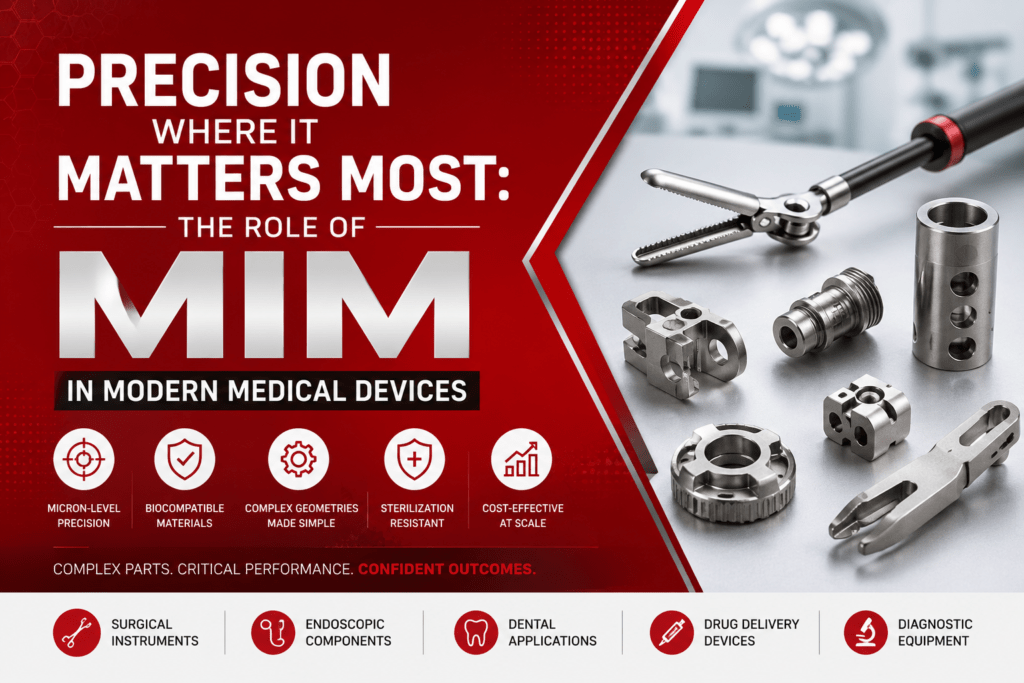
In medicine, precision is not optional. A surgical instrument that fails during a procedure, an implant that corrodes inside the body, or a drug delivery component with inconsistent dimensions can directly impact patient outcomes. As medical technology continues to evolve, manufacturers need components that are smaller, stronger, more reliable, and capable of meeting strict regulatory standards.
Metal Injection Molding (MIM) is becoming a preferred manufacturing solution for modern medical devices because it combines high precision, material performance, and scalable production in a way traditional manufacturing methods often cannot achieve.
The growing challenge in medical device manufacturing
Medical devices are becoming increasingly compact and sophisticated. Minimally invasive surgical instruments require tiny moving mechanisms and intricate geometries within extremely small spaces. Diagnostic equipment demands high dimensional accuracy, while implant-adjacent components require exceptional corrosion resistance and biocompatibility.
Traditional manufacturing methods such as machining, casting, and stamping can meet some of these requirements individually, but achieving all of them together often increases production complexity and cost. MIM helps solve these challenges by enabling manufacturers to produce complex, high-performance metal parts efficiently and consistently.
Why MIM is ideal for medical applications
1. Biocompatible materials
MIM supports the use of medical-grade materials such as 316L stainless steel, 17-4PH stainless steel, and titanium alloys. These materials are widely used in surgical instruments, endoscopic systems, and implant-related applications because of their excellent corrosion resistance and compatibility with the human body.
Titanium-based MIM components are especially valuable in applications requiring lightweight strength and high biological inertness.
2. Miniaturization without sacrificing performance
One of the biggest advantages of MIM is its ability to manufacture highly detailed components with extremely small features. Thin walls, internal channels, threads, grooves, and complex curvatures can all be produced in a single molding cycle.
This reduces the need for multiple machined parts and minimizes assembly-related tolerance issues. The result is a more compact, reliable, and cost-effective medical component.
3. Sterilization resistance
Medical devices must endure repeated sterilization processes, including autoclaving, gamma radiation, ethylene oxide exposure, and plasma sterilization. MIM components made from stainless steel maintain their structural integrity and dimensional stability through these harsh conditions, making them suitable for long-term medical use.
4. High-quality surface finish
Surface quality is critical in clinical environments where cleanliness and sterilization are essential. MIM components can achieve excellent as-sintered surface finishes and can further undergo secondary processes such as electropolishing, grinding, and passivation to meet demanding medical standards.
Common medical applications of MIM
1. Surgical instruments
MIM is widely used to manufacture components for laparoscopic tools, clip applicators, needle holders, retractors, and other precision surgical instruments.
2. Endoscopic systems
Complex articulation mechanisms, locking systems, and miniature structural components for endoscopes can be efficiently produced using MIM technology.
3. Dental devices
Dental implant components, orthodontic brackets, and prosthetic attachment systems benefit from the precision and strength provided by MIM manufacturing.
4. Drug delivery systems
Pen injectors, inhaler mechanisms, and metering valve components require consistent dimensional accuracy to ensure precise dosing. MIM provides the repeatability necessary for these critical applications.
5. Diagnostic equipment
Fluid handling systems, connectors, and laboratory instrument components often rely on MIM for compact, high-precision manufacturing.
Quality and consistency in medical manufacturing
Medical device manufacturing demands strict quality control and traceability. MIM production processes support detailed inspection, material traceability, dimensional verification, and process validation to ensure components consistently meet required specifications.
This level of manufacturing consistency is essential for companies operating under medical quality management systems such as ISO 13485 and FDA regulatory frameworks.
The future of MIM in healthcare
As medical technology continues to advance, the demand for smaller, lighter, and more complex components will continue to grow. Metal Injection Molding is well-positioned to support this evolution by delivering high-performance metal parts with exceptional precision, repeatability, and production efficiency.
From minimally invasive surgical tools to advanced diagnostic systems, MIM is helping shape the next generation of medical innovation.