
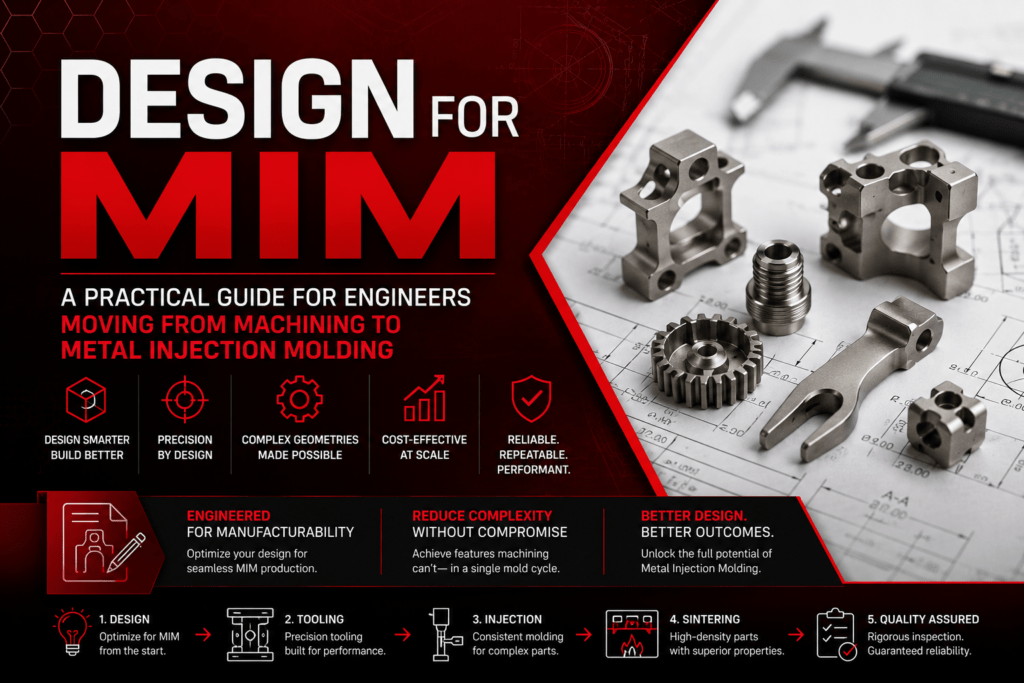
Switching a component from CNC machining to Metal Injection Molding is not simply a manufacturing decision. It is a design opportunity. Engineers who understand design for metal injection molding can unlock features and geometries that machining cannot produce economically. Those who treat MIM as a direct replacement for machining often miss its biggest advantages.
This guide covers the core design principles, common mistakes, and practical decision criteria that Meta Build Industries shares with engineering partners at the beginning of every project.
Is your part a good MIM candidate?
The strongest MIM candidates usually share several characteristics:
1. High complexity with small-to-medium size
Parts weighing between 0.1g and approximately 250g with multiple features such as undercuts, internal channels, threads, bosses, and complex curvatures are ideal for MIM.
2. Production volumes above 5,000 parts per year
Tooling investment becomes highly cost-effective at moderate to high production volumes. Below 1,000 parts annually, machining may still remain the more economical option.
3. Tight tolerances
MIM achieves approximately ±0.3% dimensional accuracy in the as-sintered condition, with even tighter tolerances possible through secondary processing.
4. Strong material performance requirements
MIM components typically achieve 97–99% theoretical density after sintering. Mechanical properties such as tensile strength, yield strength, and hardness are comparable to wrought materials.
Core design rules for metal injection molding
1. Wall thickness
Uniform wall thickness is one of the most important principles in MIM design. Uneven wall sections can cause differential shrinkage during sintering, leading to warping, cracking, or dimensional inconsistencies.
The recommended wall thickness range is between 1.5mm and 6mm. Walls below 1mm are achievable but require tighter process control, while walls above 8mm may create internal porosity issues. Wall thickness ratios should ideally remain below 3:1.
2. Draft angles
Draft angles are required on surfaces parallel to the mold opening direction to ensure smooth part ejection. A minimum draft angle of 1° is recommended, while textured or more complex surfaces may require 2° to 3°.
3. Holes and channels
MIM can efficiently produce through-holes, blind holes, and internal channels. Through-holes can be manufactured down to approximately 0.5mm in diameter. Blind holes should maintain a depth-to-diameter ratio below 4:1 for proper binder removal.
4. Threads
Both internal and external threads can be molded directly into the component. External threads larger than M2 generally require no secondary machining. Fine threads or precision thread fits may still require post-sintering tapping.
5. Undercuts
Undercuts are one of the areas where MIM significantly outperforms traditional machining. Internal and external undercuts that normally require multi-axis machining can often be created in a single molding cycle using side actions or lifters within the mold.
6. Radii and sharp corners
Internal corners should include a minimum radius of 0.3mm, although 0.5mm or larger is preferred for better material flow and reduced stress concentration. Small chamfers or radii on external corners improve part ejection and reduce stress risers.
Quick reference guide for MIM design
1. Ideal wall thickness
1.5mm to 6mm
2. Minimum draft angle
1°
3. Minimum through-hole diameter
0.5mm
4. Maximum blind hole depth-to-diameter ratio
4:1
5. Maximum wall thickness ratio
3:1
6. Minimum internal corner radius
0.3mm
7. Typical sintering shrinkage
15–20%
8. Standard dimensional tolerance
±0.3% as-sintered
Common design mistakes to avoid
1. Treating MIM as a direct replacement for machining
Every feature should be reviewed during redesign. MIM allows engineers to consolidate multiple machined parts into a single component and integrate features that would otherwise be too expensive to machine.
2. Ignoring shrinkage compensation
MIM parts typically shrink by approximately 15–20% during sintering. This shrinkage is predictable and compensated for during mold design, but engineers should consider it when planning tooling timelines.
3. Specifying unnecessarily tight tolerances
Tighter tolerances increase secondary processing costs. Critical tolerances should only be specified where truly necessary.
4. Designing overly large parts
Components above 200–250g can become less economical for MIM production. At that size range, investment casting may become a competitive alternative.
5. Neglecting gate location
The injection gate leaves a small mark on the component surface. Gate positioning should be finalized during tooling design, especially for sealing surfaces or visible cosmetic areas.
Frequently asked questions
1. What is design for metal injection molding?
Design for Metal Injection Molding (DfMIM) is the process of optimizing component geometry to fully utilize the advantages of MIM, including complex geometries, high precision, and strong material performance at scale.
2. How does MIM shrinkage affect design?
MIM components shrink approximately 15–20% during sintering as the binder is removed and the metal particles densify. This shrinkage is fully predictable and compensated for in the tooling design. Engineers do not need to adjust CAD dimensions manually.
3. What is the minimum wall thickness for MIM?
The practical minimum wall thickness is approximately 0.5mm, although the recommended range for optimal dimensional stability and process consistency is 1.5mm to 6mm.
From design to first article
Once a design is finalized and tooling is approved, the typical timeline at Meta Build Industries is approximately 8–12 weeks for production tooling and first article samples. First article inspections include complete dimensional reports with CMM verification, along with material certifications and process documentation.