
The Competitive Pressure Facing Drone Manufacturers
The commercial drone market is evolving rapidly. Whether producing UAVs for agriculture, surveying, inspection, defense, logistics, or consumer applications, manufacturers face the same challenge: deliver lighter, stronger, more complex products while reducing costs and scaling production.
Many small and mid-sized drone OEMs continue to rely on CNC machining, casting, stamping, or fabricated assemblies for critical metal components. While these processes work well at lower volumes, they often become bottlenecks when product demand increases.
This is where Metal Injection Molding (MIM) deserves serious consideration.
MIM combines the design freedom of plastic injection molding with the material properties of high-performance metals, enabling manufacturers to produce complex, precision-engineered components at scale.
What Is Metal Injection Molding (MIM)?
Metal Injection Molding is a manufacturing process that blends fine metal powders with a polymer binder to create a feedstock. This feedstock is injection molded into complex shapes, debound, and then sintered into dense metal parts.
The result is:
- Near-net-shape components
- High dimensional accuracy
- Excellent surface finish
- Reduced machining requirements
- Consistent quality across large production runs
For drone manufacturers, MIM is particularly attractive because it enables lightweight yet durable metal components that would otherwise require extensive machining.
Drone Components That Can Be Manufactured Using MIM
Many metal drone components are excellent candidates for MIM production.
Airframe & Structural Components
- Motor mounting brackets
- Propeller hub adapters
- Folding arm hinges
- Frame connector joints
- Structural reinforcement brackets
- Landing gear joints
- Payload mounting brackets
- Camera mounting hardware
- Gimbal structural supports
- Quick-release attachment mechanisms
Flight Control & Mechanical Systems
- Servo gears
- Gearbox housings
- Actuator linkages
- Control arm connectors
- Mechanical locking mechanisms
- Release mechanisms
- Spring retainers
- Precision pivots
- Bearing housings
Propulsion System Components
- Motor end caps
- Motor housing components
- Rotor retention components
- Shaft collars
- Cooling fin structures
- ESC heat sink components
- Motor mounting flanges
Camera and Gimbal Components
- Gimbal yokes
- Gimbal brackets
- Camera stabilization arms
- Precision pivot joints
- Lens mounting rings
- Sensor mounting brackets
Payload Delivery Systems
- Cargo release hooks
- Trigger mechanisms
- Locking latches
- Payload retention systems
- Winch gear components
- Cable guide systems
Communication and Electronics Housing Components
- Antenna mounting brackets
- RF shielding components
- Connector housings
- Electronic enclosure frames
- Sensor mounting hardware
Defense and Industrial UAV Components
- Ruggedized hinges
- Precision targeting mechanism components
- Optical system mounts
- Environmental sealing hardware
- Weapon-system interface brackets (where legally applicable)
- Mission payload attachment hardware
Fasteners and Specialized Hardware
- Custom threaded inserts
- Specialized nuts
- Locking fasteners
- Retaining clips
- Precision spacers
- Cable retention components
- Multi-function mounting hardware
Conventional Manufacturing vs MIM
| Factor | CNC Machining | Investment Casting | Stamping | MIM |
|---|---|---|---|---|
| Complex Geometry | Moderate | High | Low | Very High |
| Material Waste | High | Medium | Medium | Very Low |
| Secondary Operations | Extensive | Moderate | Moderate | Minimal |
| Dimensional Accuracy | Excellent | Good | Good | Excellent |
| Surface Finish | Good | Moderate | Good | Excellent |
| Small Features | Difficult | Moderate | Limited | Excellent |
| Production Scalability | Moderate | Good | Excellent | Excellent |
| Cost at High Volumes | High | Medium | Low | Very Low |
| Design Freedom | Moderate | Good | Limited | Excellent |
Why This Matters
A CNC-machined drone hinge may require:
- Multiple machining operations
- Tool changes
- Deburring
- Inspection
- Assembly of separate features
The same component produced through MIM can often be manufactured as a single integrated part, dramatically reducing labor and process complexity.
Cost Savings Opportunities
1. Reduced Material Waste
CNC machining removes material from a solid billet, often wasting 50–80% of the original stock.
MIM uses only the material required to create the part geometry, resulting in significantly higher material utilization.
2. Lower Labor Costs
MIM reduces:
- Setup time
- Machining hours
- Tool changes
- Secondary finishing
- Assembly operations
The labor savings become substantial as production volumes increase.
3. Consolidation of Multiple Components
Many drone assemblies consist of several machined parts fastened together.
MIM enables engineers to combine multiple features into a single molded component, reducing:
- Part count
- Inventory complexity
- Assembly time
- Quality issues
4. Reduced Tooling Over Product Lifecycle
Although MIM tooling requires an initial investment, the cost is spread across thousands or millions of parts.
For manufacturers planning long-term production, total cost per part often decreases significantly.
Scalability: The Long-Term Advantage
One of the strongest arguments for MIM is scalability.
Early Growth Phase
Many drone startups begin with:
- CNC prototypes
- Low-volume machining
- Limited production runs
This approach is ideal for validation but becomes expensive when demand grows.
Production Growth Phase
As volumes reach:
- 5,000 units/year
- 10,000 units/year
- 50,000 units/year
- 100,000+ units/year
Machining costs often increase linearly with volume.
MIM, however, benefits from economies of scale.
Illustrative relative manufacturing cost per part
Machining costs often increase linearly with volume.
MIM, however, benefits from economies of scale.
Illustrative relative manufacturing cost per part.
Example showing how MIM becomes more cost-effective as production volume increases.
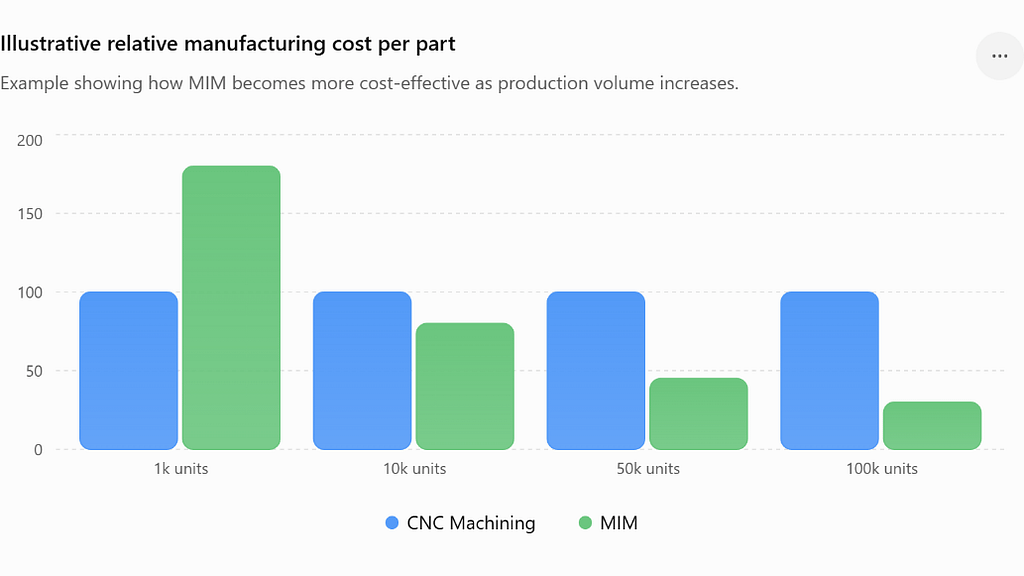
Illustrative example only. Actual savings depend on geometry, material, tolerances, and production requirements.
Raw Material Flexibility: More Options Than Many Engineers Realize
A common misconception is that MIM only works with a handful of metals.
In reality, MIM supports a broad range of engineering materials.
Stainless Steels
- 316L
- 304L
- 17-4 PH
- 420 Stainless
Benefits:
- Corrosion resistance
- Strength
- Environmental durability
Low Alloy Steels
- Fe-Ni alloys
- Fe-C alloys
- High-strength structural grades
Benefits:
- High mechanical strength
- Cost efficiency
Titanium Alloys Benefits:
- Exceptional strength-to-weight ratio
- Corrosion resistance
- Aerospace-grade performance
Tool Steels Benefits:
- Wear resistance
- Durability
- Precision mechanisms
Soft Magnetic Materials Benefits:
- Electromagnetic applications
- Sensor systems
- Motor-related components
Nickel-Based Alloys Benefits:
- High-temperature resistance
- Harsh-environment durability
Design Freedom Creates Better Drones
Traditional manufacturing often forces engineers to design around manufacturing constraints.
MIM reverses this relationship.
Engineers can incorporate:
- Internal features
- Undercuts
- Thin walls
- Integrated mounting points
- Complex geometries
- Weight-reduction structures
without dramatically increasing production costs.
This enables lighter drones with improved performance and reduced assembly complexity.
When Should a Drone Manufacturer Consider MIM?
MIM becomes especially attractive when:
✅ Parts are complex
✅ Annual volume exceeds several thousand units
✅ CNC costs are becoming difficult to control
✅ Weight reduction is important
✅ Assembly simplification is a goal
✅ Consistent quality is required
✅ Long-term production scaling is planned
Conclusion
For small drone manufacturers, the question is no longer whether Metal Injection Molding is suitable for aerospace-grade components—it is whether continuing with conventional manufacturing methods is limiting future growth.
MIM offers a compelling combination of:
- Complex geometry capability
- Significant cost reduction potential
- Material flexibility
- High precision
- Lower assembly requirements
- Excellent scalability
As drone markets become more competitive and production volumes increase, manufacturers that evaluate MIM early can position themselves for lower costs, faster growth, and greater design freedom. The companies that integrate scalable manufacturing strategies today will be better prepared to meet tomorrow’s demand without sacrificing performance, quality, or profitability.
Author: KANAV CHHATBARCEO
META BUILD INDUSTRIES.